
Ogle Parole and Probation Compared
Illinois uses several terms for supervision outside a jail or prison. Probation is a sentence imposed by the circuit court. The Ogle court file shows whether probation was ordered, its length, and the conditions entered in the case. Parole applies mainly to people eligible under older indeterminate-sentence law. Mandatory supervised release, or MSR, is the usual supervised period after many modern determinate Illinois prison terms. IDOC provides field supervision for parole and MSR, while the Illinois Prisoner Review Board sets conditions and decides qualifying parole and revocation matters.
A person can leave Ogle County Jail to begin probation without ever entering IDOC custody. Another person may leave an IDOC prison on MSR. A third may transfer from Ogle Jail to IDOC and remain confined. Each event has a different record trail.
| Supervision type | Where it begins | Best verification record | Responsible system |
|---|---|---|---|
| Probation | Ogle court sentence | Judici docket and sentencing order | Local circuit probation |
| Parole | PRB grant in an eligible case | PRB decision plus current IDOC status | IDOC supervision and PRB conditions |
| MSR | Release after an IDOC term | IDOC status, date fields, and PRB records | IDOC supervision and PRB conditions |
Verify Ogle Post-Release Supervision
Start with the sentence, not a broad name search. If the person had only an Ogle case and county-jail stay, the court chronology is central. If the court committed the person to state prison, the IDOC record becomes central. An Ogle mittimus, the document directing custody under the sentence, can appear in an IDOC sentencing block after state intake.
- Match the case. Use the Ogle case number when possible. Confirm the name, charge, disposition, and sentencing date in Judici or the Circuit Clerk record.
- Identify the sentence. Look for probation, a county-jail term, or commitment to IDOC. A prison sentence does not prove community release.
- Check current state status when applicable. In IDOC, compare Offender Status and Location with Admission Date, Last Paroled Date, Projected Discharge Date, and every Sentence Discharged? flag.
- Read the right PRB record. Use a current calendar only to verify that a proceeding was scheduled. Read En Banc minutes or revocation results for an outcome.
- Confirm the physical transition. For an Ogle Jail exit, obtain the sheriff’s discharge or transfer timestamp and destination. For prison release, verify the IDOC status after the decision.
A past Last Paroled Date does not override a present “in custody” status. Likewise, one sentence marked discharged does not settle the case if another sentence remains active. If the Ogle jail record says “transfer,” follow the receiving agency instead of describing it as community release.
Eligibility also shapes the search. People sentenced under older, indeterminate Illinois law may qualify for discretionary parole under the governing formula. Most people serving modern determinate prison terms are not waiting for that kind of parole grant. Except for natural-life sentences, they ordinarily serve the imposed term less lawful credit and then enter MSR. Natural life does not allow parole or release without executive clemency. The sentencing date, statute, and judgment therefore matter before a PRB calendar is consulted. Directing every IDOC record to a parole-hearing search can create a proceeding that does not exist.
Ogle Parole Hearing Records
The Illinois Prisoner Review Board publishes monthly hearing calendars, En Banc information and minutes, MSR material, and separate revocation schedules and results. These sources serve distinct purposes. A calendar places a matter on a planned docket. It does not state that parole was granted, that prison processing finished, or that the person crossed the gate. Calendars can also be revised, so preserve the month and revision date when documenting a proceeding.
The PRB En Banc source is the better lead for case-specific decisions and reasoning. The captured source screen below illustrates where that decision material is organized.
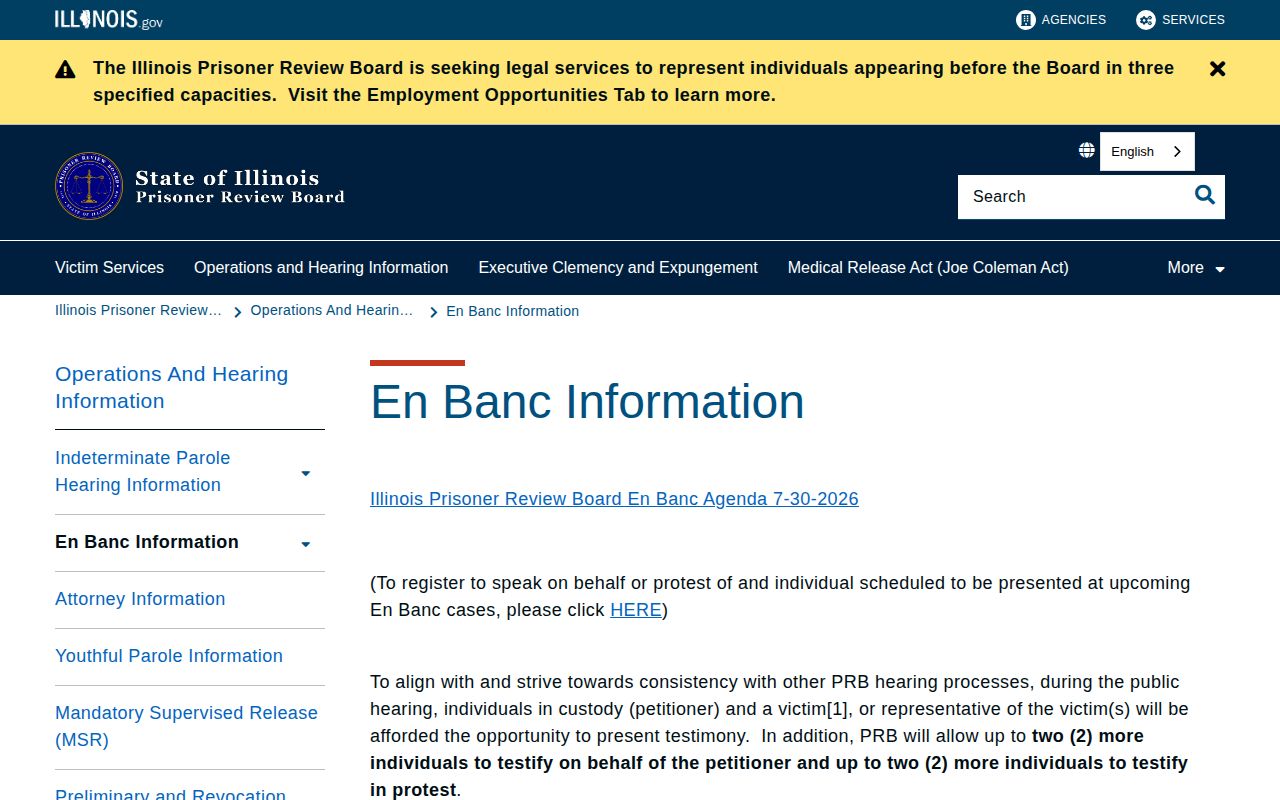
A “granted” decision sets a legal path but is not an actual release timestamp. A denial may set later rehearing treatment. A continuance leaves the matter unresolved. Revocation results deal with alleged violations after supervision began, not a first release from prison. After any PRB outcome, check the IDOC record for current custody and status.
Ogle Supervision Record Contacts
No universal public Ogle probation lookup was identified. The Ogle Circuit Clerk file is the public starting point for a probation sentence, and the official county probation department is the operational contact when disclosure is lawful. Private reporting details, compliance notes, and a person’s planned movements may not be public. Ask for a named public record rather than an open-ended account of supervision.
Records and supervision routes
Ogle County Circuit Clerk
106 S. 5th St., Oregon, IL
815-732-1130
circuitclerk@oglecountyil.gov
IDOC Public Information
217-558-2200
Verification mail: 1301 Concordia Court, P.O. Box 19277, Springfield, IL 62794-9277
PRB Victim & Witness Services
217-782-7273 or 800-801-9110
prb.victimservices@illinois.gov
Use the clerk for the filed Ogle sentence and docket. Use IDOC for the current state-corrections record. Use PRB material for Board proceedings and conditions within its authority. None of these offices substitutes for the Sheriff’s record of when a person physically left Ogle County Jail.
Ogle Supervision Violations and Warrants
Conditions are legal duties attached to probation, parole, or MSR. Illinois law authorizes parole and MSR conditions that can include reporting to an IDOC agent. The exact terms belong in the official order or supervision record. They should not be inferred from another person’s case. Probation conditions instead flow from the Ogle court sentence and later orders.
A missed probation duty may lead to a court petition or warrant. An alleged parole or MSR violation can lead to IDOC custody and a PRB revocation process. “Absconder” is an agency status, not a conclusion to draw from an old address, missed court news, or an absent web result. No official Ogle-specific absconder list was found. Verify a warrant in the current court record or cite the responsible agency’s exact designation.
Property After Ogle Jail Release
Ogle’s post-release property rule is a practical part of the local supervision picture. Personal property must be collected within 30 days after release or transfer. When someone authorizes property release within 72 hours after arrest, the detained person must provide authorization and the person collecting it must show government-issued identification. A transfer to IDOC, USMS, or another jurisdiction does not erase that deadline.
The 2023 jail inspection also treats signed, itemized property receipts as permanent jail records. That makes the receipt useful when there is a dispute over what was stored or collected. Request it from the Sheriff by the person’s identity and custody episode. This record proves a property transaction, not probation compliance, parole status, or the legal reason for release.
How Ogle Supervision Ends
Supervision ends through the process that created it. The court record should show completion, discharge, modification, or revocation of Ogle probation. For parole or MSR, use the current IDOC record and the relevant PRB material. A projected date is not a completed discharge. Nor does a past release event prove that supervision stayed unchanged afterward.
For a formal record, ask the correct custodian for an existing document. Give the full name, date of birth if known, case or IDOC number, and the specific custody or supervision period. The Ogle Clerk can supply fuller or certified court material when an online docket is abbreviated. IDOC should correct IDOC fields. The Sheriff controls Ogle booking, discharge, and transfer records. Keeping those sources separate produces a clear timeline: sentence, physical release or transfer, supervision, later violation if any, and final discharge.
Illinois public-record access can reach existing records, subject to exemptions, but it does not force an office to create a custom supervision report. A focused request should name the document or event. Ask the clerk for the sentencing or discharge order, PRB for its published decision material, or IDOC for the state record it maintains. If a field is wrong, send the correction request to the office that created that field and attach the conflicting official document.
Completion should be dated from the controlling source. A probation term may end through an Ogle court order, while an IDOC record may distinguish release to MSR from later sentence discharge. PRB calendars and minutes can explain a proceeding, but they do not replace current IDOC status. Keep the final supervision event separate from the earlier jail or prison exit. When dates differ, name the agency and event attached to each one instead of merging them into a single release date.
Public Record Search
Sponsored Results