
Ogle County Released Inmate Records
“Released” means that one agency’s custody ended. It does not always mean the person entered the community. Someone may leave Ogle County Jail after judicial pretrial release, dismissal, a county sentence, time served, or another authorized event. The same building also sends people to IDOC, returns federal detainees to the U.S. Marshals Service, and transfers people to other jurisdictions. A transfer closes Ogle custody while detention continues elsewhere.
The release record answers the narrow physical-custody question: when did Ogle receive the person, when did it discharge or transfer that person, and what destination or release code was recorded? Judici can explain the court event. VINE can report a status change. The Ogle Safe App is the sheriff-endorsed current inmate-search channel. None should be made to prove facts that belong to another source.
Ogle County Release Types
The event label and destination matter more than a person’s disappearance from a live search. Preserve the agency’s wording. A court may authorize release before jail processing finishes, and one case can end while another warrant or detainer keeps the person confined.
| Recorded path | What it means | Where to verify next |
|---|---|---|
| Pretrial release | The case continues outside jail under court terms. | Ogle docket plus jail discharge time |
| Time served or sentence complete | The controlling county term ended, subject to other holds. | Sentence, credit calculation, and jail record |
| Probation | A court sentence begins or continues in the community. | Sentencing order and Ogle court chronology |
| IDOC transfer | Ogle custody ended but state prison custody begins. | Receiving agency on Ogle record, then IDOC status |
| USMS or outside transfer | Another agency continues custody. | Destination and receiving custodian |
| MSR after prison | Physical prison release begins state supervision. | IDOC status and PRB material |
Fields in Ogle Release Records
Request enough fields to identify one custody episode and distinguish community release from a handoff. Illinois law expressly includes the time and date received into, discharged from, or transferred from agency custody within specified chronological arrest information. A booking sheet without an exit field does not fully answer the release question.
| Field | What it establishes |
|---|---|
| Name, birth date, booking ID | Connects the record to the correct person and episode. |
| Arresting agency | Identifies who initiated the booking. |
| Admission date and time | Shows when Ogle custody began. |
| Charge and case number | Links the booking to the court chronology. |
| Discharge or transfer date and time | Shows when Ogle custody physically ended. |
| Release or disposition code | Preserves the agency’s reason or event label. |
| Destination or receiving agency | Separates community exit from continued custody. |
| Hold or detainer | Identifies another legal basis affecting departure. |
| Photo and property receipt | Supplies related booking identification and property documentation. |
Illinois FOIA does not create one universal jail-record retention period. Ogle publishes no online archive duration. If an old record is absent online, ask whether the Sheriff retains it under an approved Local Records Commission schedule. “Not displayed” and “not retained” are different answers.
Request Ogle County Release Records
The Sheriff holds Ogle jail booking, discharge, transfer, photograph, and related property records. The Circuit Clerk holds the court file. IDOC holds state-prison records. Send the request to the office that created the needed document. Ogle’s county FOIA page routes Sheriff requests through the elected office’s GovQuest entry. A written form is convenient, but the request should focus on existing records rather than asking the office to research a narrative.
- Define the episode. Give the full name, birth date if known, approximate booking date, and case or booking number. Add the arresting agency for a common name.
- Name the fields. Ask for the booking sheet, admission and exit timestamps, release or transfer code, destination, hold information, and photograph when relevant.
- Use the Sheriff channel. Submit through GovQuest or another official written route and save the exact request and confirmation.
- Track the response. Noncommercial Illinois requests ordinarily receive a response, denial, or extension notice within five working days, counted from the next day. A permitted extension may add up to five working days with written reasons.
- Review the result. If the record says transfer, require the receiver. If a field is withheld, retain the written exemption. Ask about the retention schedule if an older item is missing.
Ogle County Sheriff
Public office: 202 S. 1st St., Oregon, IL
815-732-1101
oglesheriff@oglecountyil.gov
Jail: 601 W. Washington Street, Oregon, IL 61061
815-732-2135
The first 50 ordinary black-and-white letter or legal pages are generally free under Illinois rules. Confirm any later-page, color, oversized, or media cost with the current records officer. Existing electronic format can reduce ambiguity and cost. FOIA does not require a custom report or answers that the office never recorded.
A precise request can seek records sufficient to show the booking and release of the named person from Ogle County Jail for a booking beginning on an approximate date. Name the booking sheet, booking photograph, date and time received, date and time discharged or transferred, release or disposition code or reason, and receiving agency or destination if transferred. This language asks for records the Sheriff may already keep and uses the same discharge-versus-transfer distinction that Illinois law recognizes.
Illinois Law for Ogle Releases
Section 2.15 of the Illinois Freedom of Information Act requires specified chronological arrest information as soon as practical and no later than 72 hours after arrest. For a person who is incarcerated, the listed information includes the time and date received, discharged, or transferred. Access can still be limited where disclosure would interfere with pending or reasonably expected enforcement, endanger safety, or compromise correctional security. Juvenile information remains outside this adult site’s scope.
Sealing or expungement can lawfully change public access. Their effects and eligibility depend on the disposition, offense, and order, so a missing Judici result does not prove that no arrest or release occurred. The Ogle Circuit Clerk links Illinois expungement resources. Corrections should start with the office that created the contested field and the official document that conflicts with it.
FOIA is an access law, not a command to preserve every item forever. It also does not require a new answer when no responsive record exists. For an older episode, request the existing record first and separately ask which approved retention schedule governs it. If an office denies or redacts material, keep the written exemption citation and response date. Court dispositions belong with the Clerk, Ogle custody timestamps with the Sheriff, and state-prison status fields with IDOC.
Property After Ogle County Release
Ogle County Jail requires personal property to be collected within 30 days after release or transfer. That rule applies even when a person went to another custodian. An authorized property release within 72 hours after arrest requires authorization from the detained person, and the person collecting the items must show government-issued identification.
Property paperwork also supplies a useful record trail. The 2023 IDOC inspection treats signed, itemized property receipts as permanent jail records. When there is a question about what remained at the jail, request the receipt by name and custody episode. It proves a property transaction, not the cause or exact time of release.
Search Ogle County Released Inmates
The best search starts with the last known custodian. Ogle has no conventional public web roster or historical release database. Its official inmate page directs users to VINE for custody and notification, the Ogle Safe App for inmate search, and Judici for court dates. A negative result is not release proof.
- Match the person. Use full name, birth information, booking or offender ID, facility, and case number. Record the date of every dynamic result.
- Check the Ogle channels. Search VINE and the Safe App where available. Preserve exact status wording. Call the jail for a current operational check.
- Read the court chronology. Use the Ogle case number in Judici. Look for detention, release, dismissal, sentence, probation, warrant, or transfer-related events.
- Follow the sentence. If the person entered Illinois prison, search IDOC. If documented federal custody followed, use the federal docket and BOP where applicable.
- Request the exit record. Ask the Sheriff for the physical discharge or transfer time, code, destination, and receiving agency.
IDOC Search for Ogle Releases
IDOC’s Individual in Custody Search applies only when the person entered Illinois state custody. Search by last name, IDOC number, or birthdate. The IDOC number is the best discriminator. Partial surname and first-name searches can help, while birthdate and physical details separate same-name records. An Ogle County mittimus can appear in a sentencing block after state commitment.
| IDOC field | How to read it |
|---|---|
| Offender Status and Location | Begin here for the current state-custody reading. |
| Admission Date | Shows entry into the IDOC episode, not departure from Ogle. |
| Last Paroled Date | Records a past transition and may not describe current status. |
| Projected Discharge Date | An administrative projection, which may show “INELIGIBLE,” not proof of release. |
| Sentence Discharged?: YES/NO | Applies to one sentencing block and must be read with all other sentences and current status. |
| Mittimus and county | Connect the state record to the correct Ogle case. |
The official IDOC inmate-search landing page leads to the live application. The captured page below identifies the state search route.
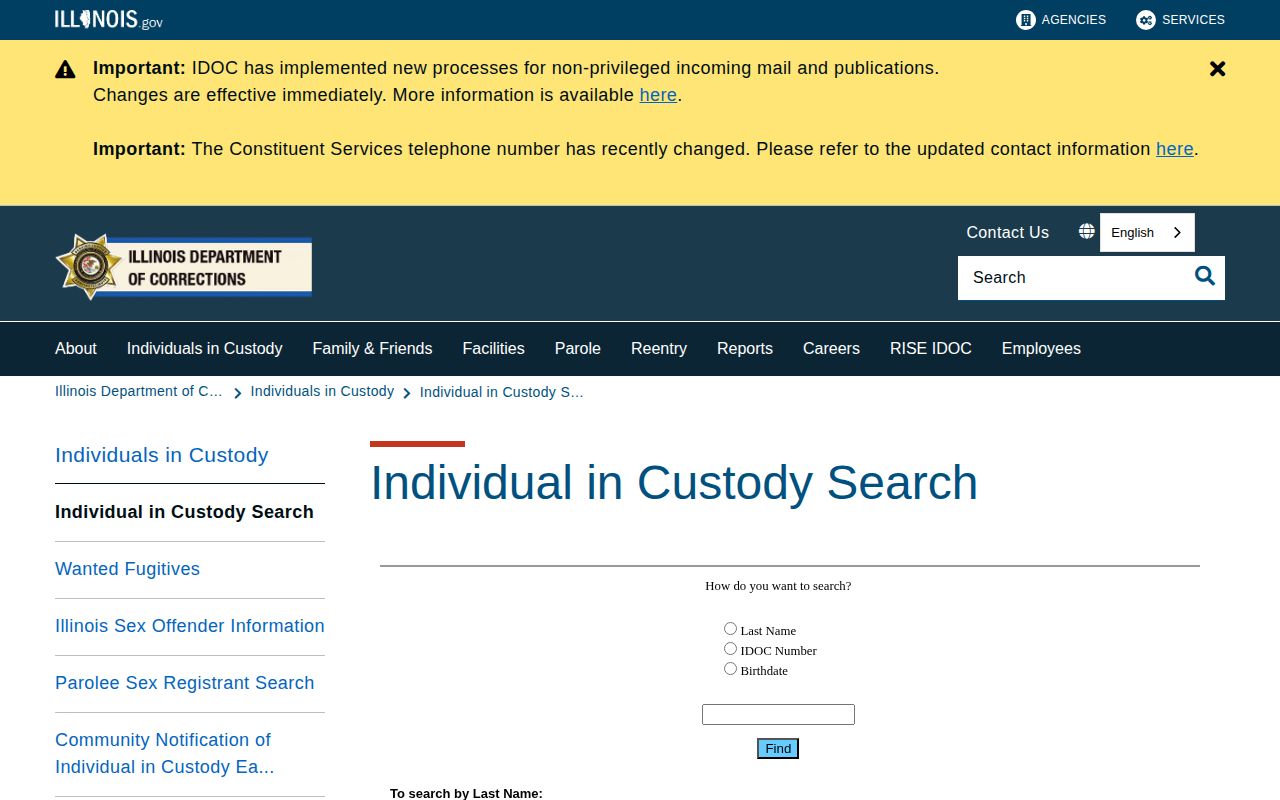
An IDOC photograph helps match a record, but status and date fields establish custody facts. A person released from Ogle Jail without a state commitment usually will not appear here.
Ogle County Recent Release Search
No official public 24-hour or 72-hour release feed was identified in Ogle County’s reviewed navigation as of July 16, 2026. The Sheriff’s inmate-information page gives VINE, the Safe App, and Judici instead. County text does not promise that the app shows a release tab, photo, time window, cadence, or archive. Those features should not be assumed.
For “who left today,” register in VINE before the expected event, save the alert, and obtain the actual Ogle exit timestamp afterward. For a retrospective window, request an existing chronological discharge and transfer log between exact start and end times. Ask for the booking identifier, timestamp, event code, and receiving agency. If no such report exists, request the individual booking records. The Sheriff need not create a custom analysis.
Judici Tracks Ogle Court Releases
Both the Sheriff and Ogle Circuit Clerk direct readers to Judici. The Sheriff uses it for inmate court dates. The Clerk links it for daily dockets and case searches. This dual endorsement makes the Ogle court chronology the practical enduring online trail after a live custody result changes.
Prefer a case number. Otherwise search the party name and compare the charge and dates. The chronology can show detention decisions, release orders, dismissal, plea, sentence, sentence credit, probation, warrants, and final disposition. Yet a court order is not the jail’s physical-exit timestamp. Processing, another case, a warrant, or a detainer can intervene. Pair the judicial event with the Sheriff’s discharge or transfer record.
Ogle Release or Custody Transfer
The March 2023 IDOC inspection says Ogle County Jail houses U.S. Marshals Service detainees and sometimes people for other jurisdictions. That local fact makes transfer the most important alternative to community release. When a person vanishes from Ogle’s live channel, ask for the receiving agency and destination before drawing a conclusion.
Released to community
Ogle records a discharge and no receiving custodian. The docket may show the authorizing event or sentence result.
Transferred from Ogle
Ogle custody ends, but a named agency receives the person. Follow IDOC, USMS, another county, or ICE only when documented.
Still in Ogle custody
A current VINE, Safe App, or jail check supports the local status. A hearing or expected date alone does not.
Unknown after a non-match
Check identifiers, court events, the jail, and the release record. Absence does not choose among the other paths.
Ogle Supervision After Release
Probation comes from an Ogle court sentence. IDOC supervises parole and mandatory supervised release, while the Illinois Prisoner Review Board sets conditions and handles qualifying hearings and revocations. Modern determinate Illinois prisoners usually move to MSR after the term less lawful credit; discretionary parole mainly concerns eligible older indeterminate cases.
For probation, read the sentencing order and later docket. For state supervision, compare IDOC’s current status and date fields with the appropriate PRB record. A PRB calendar shows a scheduled proceeding, not release. A past Last Paroled Date does not override a present in-custody status.
Federal Search for Ogle Releases
Use the BOP locator only when the person entered federal prison, generally for records after 1982. A past release date with no institution or a location marked “RELEASED” means out of BOP custody as shown. It does not settle federal supervision, state custody, immigration custody, or another restriction. “IN TRANSIT” is not community release.
Ogle’s USMS holding does not mean every federal detainee entered BOP. For federal pretrial custody, use the federal docket and a focused agency inquiry. ICE’s locator covers current detainees and people released from ICE custody within a short stated period, but it matters only when an immigration event is documented. An Ogle-to-ICE transfer and a later ICE release are separate events.
Ogle Jail Release Statistics Limits
The current Ogle County Jail was constructed in 2020. Its March 8, 2023 IDOC inspection lists rated capacity at 162 and counts 41 people on that inspection day. Those are dated facility and point-in-time facts. They are not annual bookings, average stay, release volume, or proof of present occupancy.
No official annual Ogle release total or average stay was found. Subtracting one day’s population from rated capacity would not produce a release statistic. A person seeking totals should request an existing calendar-year report or export and allow transfers to remain labeled separately from community releases.
Is Ogle Work Release Final?
No. Ogle periodic imprisonment and work release remain forms of custody. A sentenced person reports with the court order, follows controlled departure and transportation-document rules, and pays the stated daily charge for the full sentence. Time outside for an approved activity is not final discharge.
Property remains stored until the sentence ends. The final release should be described only when the periodic term or another controlling custody actually ends. A court’s expected completion date can still differ from physical exit because of processing, another warrant, a detainer, or transfer.
Ogle County Release Facility
Ogle County Jail is the only adult detention facility identified for a local facility page. It holds local pretrial and sentenced adults, periodic-imprisonment participants, and at times federal or outside-jurisdiction detainees. A person can enter the community, begin probation, complete a county term, transfer to IDOC, or return to another agency. The destination controls the next search.
- Ogle County Jail, 601 W. Washington Street, Oregon, Illinois, 815-732-2135
Public Record Search
Sponsored Results